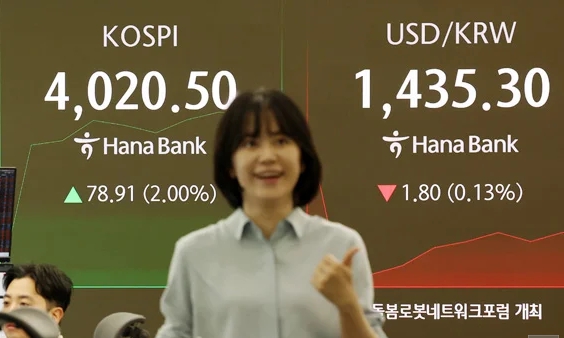
The KOSPI surpassed the 4000 mark for the first time ever, ushering in a new era in the history of Korea's capital market. For the first time in 42 years since the introduction of the index system in 1983, it has surpassed the '4000 mark ,' raising its profile on the global stock market stage. Despite major shocks such as the foreign exchange crisis (1997), global financial crisis (2008), and COVID-19 pandemic (2020), the Korean market has not shaken off the label of 'undervalued stock market,' but it is now being reevaluated as a market with a structural growth foundation. According to the Korea Exchange on the 27th, the KOSPI opened at 3,999.79, up 1.48% from the previous day, quickly breaking through the 4,000 mark. This is significant as it is not a short-term technical rebound but a structural rise that confirms changes in market strength. Past liquidity Unlike the market that was expected to rise, analysts say that currently, a real economy-driven rally is unfolding, driven by corporate profits and strengthening industrial competitiveness. In particular, the AI semiconductor industry has been the catalyst for a reevaluation of the Korean stock market; Samsung Electronics and SK Hynix have risen 16.7% and 36.4% respectively over the past month, with their combined market capitalization reaching 1,019 trillion won, surpassing 1,000 trillion won for the first time ever. Amid global AI investment competition, the explosive demand for HBM (High Bandwidth Memory) is driving a rebound in the semiconductor industry, and is being evaluated as rewriting the growth narrative of the Korean stock market. The supply and demand flow has also changed. According to the Korea Exchange, the average daily trading volume on the KOSPI from October to the 24th was 16.653 trillion won, the highest in 4 years and 4 months since June 2021 . It is said to be the highest level. This means the market is feeling like a 'market where money returns,' and foreign investor inflow is cited as the key driver behind the market's rise in size. The market capitalization held by foreigners was 1,125 trillion won (34.7% of holdings), up 493 trillion won from a year earlier, driven by foreign capital flowing into Korea's major export sectors such as semiconductors, automobiles, and shipbuilding, driving the index higher.
Comments 0
Log in to comment.